Zabrze. Attractions of mining and post-industrial tourism

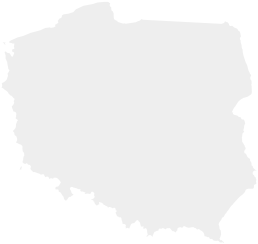
- Zabrze is a mining town in Upper Silesia, known for its unique industrial attractions.
- The most important attractions are the Historic Guido Mine, the Queen Louisa Adit and the Maciej Shaft.
- The Queen Louise Adit offers the possibility of rafting in underground corridors.
- Parking in the center is paid, but there are convenient parking lots available at the attractions.
Zabrze is a mining town located in the Silesian Voivodeship, within the Upper Silesian conurbation. It lies between Gliwice and Bytom, near Tarnowskie Góry, on route No. 78. Zabrze has many faces. As a city, it may not impress with its charms and wonderful buildings, but it offers some really interesting attractions that you will not find in almost all of Poland. They are worth a visit, all the more so because beautifully revitalized, they not only testify to the history of these lands and are a valuable trace of tradition, but also offer family recreation at a high level. Join our guide to Zabrze!

Experiences in Zabrze. Map of experiences
Today, when mining in Upper Silesia was heavily restructured and reduced, post-mined objects, such as numerous shafts, underground corridors and chambers, ceased to be frequently used. However, they often gain a new face and a new function. They have become great attractions for tourists, at the same time being an authentic trace of the past and a valuable souvenir of technical thought. They attract more and more visitors, not only from the area, but even from abroad. But of course, it is not only the mines in Zabrze that we will find. Get to know the best attractions of Zabrze!
1. Guido Mine in Zabrze
The historic Guido Mine in Zabrze is a real hit for tourists. Not only from Upper Silesia, which has been soaked with this topic since childhood, but also from all over Poland, and even from outside its borders. This is a unique opportunity to learn about the reality of the hard work of miners and visit places that for years were only available to underground workers. It's a fantastic adventure! While exploring the Guido Mine - a former coal mine, you can explore different levels: 170 m, 320 m and 355 m. On them, you will visit a concert hall at the level of 320 m underground or survive a business trip, i.e. a day tour of 355 m underground. The mine is one of the stars of the Technology Route of Technical Monuments of the Silesian Voivodeship.
Address: ul. 3 Maja 93

2. Queen Louise Adit in Zabrze
The Queen Louise Adit is a valuable and extensive underground and above-ground complex, which consists primarily of the former Queen Louise Mine and the Main Key Hereditary Adit that drained it. It is actually the first state mine in Upper Silesia, called the queen of Silesian mines. It was built at the end of the 18th century, and today, together with the Adit, it forms a wonderful tourist attraction open to visitors. It offers an underground walk and the longest underground rafting in Poland. It's an amazing adventure!
And did you know that when the Main Key Hereditary Adit was unblocked, only the work of human hands was used? Shovels were used to load mud onto wheelbarrows, and these were taken to the outlet of the Adit at Miarki Street and to the Carnall Shaft, from where it was pulled to the surface with a bucket. The layer of silt sometimes reached 3 meters. According to estimates, it was carried out of the Adit about 19,000 tons, which gives 750,000 full wheelbarrows.If they were placed next to each other, they would create a trail from Zabrze to Gdańsk, about 500 km!
Address:ul. Mochnackiego 12

3. Water tower in Zabrze
The water tower is an element of the modern Museum of Coal Mining and a great opportunity to get into history, but also into the world of science and simply experience interesting views. The tower was erected in 1909 and is today an impressive example of industrial architecture. This is because its construction, based on an octagonal plan, is peculiar. It is distinguished by its monumental character, but the shape is not everything. It is a unique place for the whole family, where every taste will be satisfied. There is a fascinating Carboneum exhibition, an impressive panorama from above and relaxation in the restaurant.
And what is this Carboneum? It is a center of knowledge about carbon, a multimedia exhibition talking about an element that was created billions of years ago in the core of a certain star, and without which it is difficult to imagine life.
Address: ul. Zamoyskiego 2
4. Museum of Coal Mining in Zabrze
The Museum of Coal Mining is the largest in Poland and one of the most important centers of mining and post-industrial tourism in Europe. The modern form of the transformed Museum makes visitors eager to visit it. They can experience adventures and get to know attractions that are in vain in most Polish cities. The Museum consists of: Guido Mine, Queen Louise Adit, Water Tower, Park 12C, Military Technology Park and Carnall Zone. The whole creates a versatile space for lovers of history, technology and mining heritage.
The Museum of Coal Mining is:
- the largest mining complex in Europe available to tourists: more than 10 kilometres of underground hiking trails
- the longest underground runoff in Europe, more than 1 kilometer long
- the deepest level of coal mining available for tourism in Europe
- europe's largest underground mining machinery park
- europe's oldest, still-operating steam engine
- deepest pub in Europe
Address: ul. 3 Maja 93, ul. Wolności 410, ul. Zamoyskiego 2

5. Maciej shaft in Zabrze
Szyb Maciej in Zabrze Maciejów is a complex of preserved and beautifully revitalized buildings of a former mining plant from the beginning of the 20th century. All the more interesting is the fact that from the former mine shaft a deep well was made, constituting a water intake. The shaft is located on the Route of Technical Monuments and is open to tourists, only with a guide. In addition, there is a delicious restaurant located on the Silesian Tastes Culinary Trail.
Address: ul. Srebrna, Zabrze Maciejów

6. Botanical Garden in Zabrze
The Botanical Garden in Zabrze is a place with the most diverse collection of plants in all of Upper Silesia. It has a unique ecological, health and scientific character. Plants can also be purchased here. In the area of the Garden, 4,500 specimens of trees and shrubs and about 200 taxa of perennials grow. Here you will find a rich collection of plants from virtually all climatic zones of the world. The garden is not very large, but it is a beautiful, colorful place, perfect for a quiet walk.
The garden in Zabrze is divided into a botanical part referring to French-style gardens and a park with a playground and farmland with greenhouses. Currently, two greenhouses are open to tourists. One is the so-called cactus house with succulents from various botanical families. The second is the palm house, where, in addition to exotic plants, such as bananas, ferns and palms, there is a pond and aquarium with fish.
Address: ul. Piłsudskiego 60, ul. Botaniczna

7. Jewish cemetery in Zabrze
The Jewish cemetery in Zabrze is an incredibly atmospheric cemetery. It is next to another cemetery. On a daily basis, it is closed by a characteristic orange gate, because devastation occurred here. However, it can be visited on November 1 and on Sunday around May 15. In addition, you can arrange an individual tour with the cemetery guardian, Dariusz Valerianski. The object dates back to the end of the 19th century and hides picturesque tombs, shrouded in ivy.
About 1,000 people of the Mosaic faith rest here. Less than 700 tombstones have survived to this day. From monumental sandstone tombs, reminiscent of those from Christian cemeteries, through more characteristic matzevot found in other cemeteries, to postal tombstones in various shapes. There are also more modern tombstones made of colored stone. Tilted by the teeth of time, stuck here and there, they remind us of the past time. Attention is drawn to the Tomb of the Böhms, made of black Swedish granite. The tombs under the wall are charming, those with ivy caps. What names will you find on the graves? Pollack, Hoffmann, Zimmermann, Kaiser, Fischer, Herzberg, Katz, Goldmann, Fridman, Rosenbund and Elsner.
Address: ul. Cmentarna 15


8. Zandka housing estate in Zabrze
The Zandka housing estate is a former workers' housing estate, which was established in 1903-22, for the employees of the nearby Donnersmarck steelworks. It is located in the so-called Little Zabrze. It is a unique place, slightly neglected on the one hand, and very atmospheric on the other. If the houses standing here were renovated, they would delight many tourists, because the charm cannot be denied! It is definitely one of the most beautiful workers' settlements in Upper Silesia. Each house on Zandka, and there are about 40 of them, has a similar projection, but different roofs, solids and decorations. They are similar, and yet everyone looks a bit different. The facades of the buildings were made largely of red brick. Some are additionally decorated with a decorative wooden frame structure. The place is not very famous, but it is worth taking a walk during the day and appreciating the old architecture.
Address: ul. Krakusa and ul. Stalmacha


9. Steel house in Zabrze
Right next to Zandka, at Cmentarna Street, you will find a characteristic steel house. It dates back to 1927 and is truly unique in Europe. At that time, several such houses were built in Silesia. They were supposed to become an ideal solution for workers, because they appeared extremely quickly, in less than a month. However, they did not last much longer, and one of the reasons was mold problems. Maybe that's a good thing, because this house looks quite strange. To this day, tenants live in it.
Address: ul. Cmentarna

10. Wooden church in Zabrze
The wooden church of St. Hedwig in Zabrze, in the Poręba district, is a powerful unique piece built in the style of modernism with elements of expressionism. It was created in the 20th century, more precisely in 1929. Of course, brick temples were erected at that time, but due to mining damage occurring in this area, it was decided to build a wooden church. Its shape and large size are very interesting. It definitely draws attention to its unusual architectural form. The structure is built on a reinforced concrete slab with a weight of 57 tons, on a plan of an oval dodecagon with four octagonal towers. It is covered with a high multi-pitched roof. This church lies on the Wooden Architecture Route of the Silesian Voivodeship.
Church of St. Jadwiga, ul. Wolności 504

11. Church of St. Lawrence in Zabrze
The neo-Gothic church of St. Lawrence stands in the district of Mikulczyce in Zabrze. The brick, impressive brick temple was built in 1892-94, but the parish of St. Lawrence existed here already in the Middle Ages. It was known in the 12th century as a knightly village. The first wooden church certainly stood on the Church Hill in 1326. It was destroyed and in the sixteenth century a new wooden and brick one was built, and when it turned out to be too small, the current temple was erected. The old man remained as a monument, but he was set on fire and now his only trace is the cross standing in the place of the former altar. The new church, on the other hand, had to contend with a tornado that broke the side tower in 1928, which pierced the roof of the temple and destroyed the organs.
Address: ul. Mariacka 1

12. Borsig workers' housing estate in Zabrze
The Borsig housing estate is the oldest workers' settlement in Upper Silesia. It was established in 1865-89. The housing estate in Zabrze was founded by the industrialist Albert Borsig, hence its name. In the mid-nineteenth century, Albert's father, August Borsig, invested his money in Biskupice, then owned by the Ballestrems, and created the industrial concern Borsigwerke, which produced locomotives. This concern has existed to this day, continuously since 1837.
The Borsig estate was created for employees of family factories. At that time, over 60 buildings were built, in which nearly 3,000 people lived. The Borsiga colony in the Biskupice district at Bytomska Street still consists of identical 4-family houses, standing in an orderly layout, at Mieczysława I, Głowackiego, Władysław IV, Rodziewiczówna, Paweł Kempka and St. Wojciech streets. Okrzei and Mikosza streets reach the estate. The houses in the Borsig estate have a modest decoration, and in the construction of these buildings, the original elements of the Prussian wall attract attention, very pleasant to the eye.
Address: Okrzei and others, Zabrze-Biskupice

13. Nowy Theatre in Zabrze
The central part of Zabrze is the Theatre Square, where the historic Gustaw Morcinek New Theatre attracts attention. The building stands next to today's Platan shopping center.
Address: Plac Teatralny 1

14. Forest Swimming Pool in Maciejów
The Forest Bathing Resort in Maciejów is organized in the district of Zabrze - Maciejów. The swimming pool allows you to relax from the hustle and bustle of the city amidst the forests during hot summer days.
Address: ul. Srebrna 10
History of Zabrze
The first mention of today's districts of Zabrze dates back to the 13th century, the oldest district is Biskupice, mentioned in 1243 in the document of Duchess Viola. At that time, the inhabitants lived mainly from farming, with time the cultivation of hops became popular here. On the border of Gliwice and Zabrze lay the great "Hops Field", the possession of which was the subject of a fierce dispute in the 17th century. The local peasants also grew flax, spun and woven at home.
In the nineteenth century, during the industrial revolution, heavy industry came to the fore in Zabrze - a hard coal mine and a smelter were created at that time thanks to Guido Henckel von Donnersmarck - a great tycoon in this region. But this process began here at the end of the 18th century, when practically the first hard coal mine in Upper Silesia was established here - the queen of Silesian mines.
It was established as a state mine, its first name is "Royal", over time it was renamed the Queen Louise mine, after the deceased wife of King Frederick William III. The Main Key Hereditary Adit, which was soon created for its drainage, was a masterpiece of that time. Today, these facilities are open to tourists in the form of the Queen Louisa Adit.

Accommodation
Here you will find a wide selection of accommodations. By booking your stay on Booking.com through our link, you support the development of our blog — and we thank you in advance! It helps us reach many interesting places that we later love to show you and share our experiences and information with you.
Rent a car
Exploring becomes much easier when you have your own means of transport. You don’t have to worry about buses or taxis, and you can plan each day your way. The search box below will help you find the right car – right where your journey begins.
What's worth seeing in the area?
You don't have to travel far to find more interesting places. Within a radius of 100 kilometers, there are many attractions waiting for you that will certainly enrich your stay Your trip with additional memories.
- Black Trout Adit in Tarnowskie Góry, distance: 13 km
- Pławniowice Palace, distance: 23.3 km
- Gródek Park in Jaworzno, distance: 38.9 km
- Błędowska Desert, distance: 53.2 km
- Eagle's Nest Trail, distance: 56.6 km
- Bobolice Castle, distance: 60.3 km
- Moszna Castle, distance: 73.6 km
- Ojców National Park, distance: 75.3 km
- Castle in Żywiec, distance: 75.4 km
- Kazimierz in Kraków, distance: 87.6 km
