Magura National Park. Attractions worth seeing in a forested mountain landscape

Magura National Park is one of the last wild refuges in Poland. Probably the wildest and most secluded. So if you are looking for solitude and breath, this is the lowest part of the Polish Carpathians for you. For 3 days of hiking on the local trails, in October, we did not meet any tourists! It is mountainous and the most forested of all Polish national parks. The land of the lesser spotted eagle and wolves, which form as many as 3 packs here. Bears can also be found on the trails. No terrible animal chased us, but we met other specimens, which I will write about below! And this symbolic door to nowhere, poignant and eloquent.
Magura National Park is one of the least known national parks in Poland. It was created on January 1, 1995 and its area covers the Magura range, from where, as you can easily guess, its name came. The park is located in the Low Beskids, south of Biecz and Gorlice, and east of Krynica Zdrój. Interestingly, although it is small, it sneaks into 2 voivodeships - Podkarpackie (90%) and Lesser Poland (10%). The landscape of the Park is dominated by low and domed peaks and gentle ridges. The highest peak in the MPN area is Wątkowa with a not very impressive height of 846 m above sea level.

Attractions of the Magura National Park
The values and attractions of the Magura National Park include both interesting, unique and rich nature, as well as picturesque monuments of sacred architecture. They show the history of coexistence of Poles, Lemkos, Jews and Gypsies in these areas. While wandering around the Magura National Park and its immediate surroundings, you will find beautiful churches shining in the sun, abandoned cemeteries and old shrines. There is also a symbolic door to the no longer existing villages from which the population was displaced.
Magura and Weft
We went to Magura and Wątkowa from the village of Bartne. These are two peaks located close to each other. The route is about 8 kilometers in both directions, along the red Papal Route. The weather was not kind on that day, thick dark clouds hanging over our heads, just waiting for the rain to fall on them. Is that why we didn't meet any tourists on the trail? Perhaps so, but on other trails of this Park we were also alone, even in better weather. The higher we went, the fogs created an increasingly atmospheric, even fairy-tale atmosphere.
On the ridge of the band there is a papal monument commemorating the visit here, then still priest Karol Wojtyła. There is also a viewpoint over the Tatras. The summit consists of two vertices. On the red signs to the right, Magura rises (829 m above sea level). The second peak lies on green trails (846 m above sea level). Both are heavily forested and it is in vain to look for views here. You will find stamps here.


Ferdel and Observation Tower
It is a peak with a height of 648 m above sea level, rising above the Limestone. At the top there is a wooden observation tower. There is a black trail here, we climbed it in the village of Wyżny Koniec. It's a short route, about 1.1 km, but steeply uphill. We walked for about 20 minutes, normally it takes about 35 minutes, but we were in a hurry. The hardship was rewarded by beautiful views and the sun leaning towards the west.


Devil's Stone and Magura Waterfall in Folusz
On the black trail and the red educational path above the Kłopotnica valley, you will meet sandstone outcrops called the Devil's Stone. According to legend, they were thrown here by the devils themselves. A little by accident, because they really wanted to drop them on the Church in Cieklin. As it continued to arrive in the vicinity of the churches, the devils were terrified that there would be fewer and fewer evil souls. So they decided to destroy the growing temple in Cieklin, throwing a huge boulder on it, found on Magura Wątkowska. However, even for the devilish creatures, its weight turned out to be too great. When the ominous dawn rose for them, their supernatural powers left them, and the stone fell with a bang, shattering into smaller pieces. Such picturesque rocks stick out to this day as a decoration of the trail.
Going further along the charming beech forest, sparkling with golden colors, you will reach the highest waterfall of the Low Beskids. It measures up to 7 meters high! Above all, it flows in a strong stream in the spring, next to the thaws. At other times of the year, it is quite thin, and yet it is very nice and charming here. There is a stamp waiting on the spot.
MPN Museum Centre in Krempna


The management of the Park is located in Krempna. A very interesting Museum Centre has also been created here, which we highly recommend you visit. The greatest impression is made here by the paid exhibition, where in the dark you go to the next, awakening dioramas. They show the life of this fragment of the Low Beskids. In addition, a number of multimedia exhibitions have been prepared, where you will also get acquainted with the nature of the Eastern Carpathians.|
Address: Jan Szafrański Educational and Museum Center in Krempna
Open all year round: V-X Tue-Sun, 7.00-17.00 (weekend from 9.00), XI-IV Tue-Fri to 7.00-15.00


Symbolic door to Nieznajowa
Have you ever heard of a symbolic door? This is one of the curiosities of this area. Once there was a village called Nieznajowa. The house by the house, in chain development, but after World War II, the local population was forced to leave these areas and the Orthodox Lemkos went to the areas of present-day Ukraine. They are Ruthenians belonging to Eastern Slavs, who once lived in large numbers in the Low Beskids. They spoke Lemko-Russian and were Orthodox or Greek-Catholic. Hence the multitude of churches and crosses or tombstones with Cyrillic inscriptions. As late as 1938, about 150,000 people lived in the Polish Carpathians. Lemkos. Currently, only 2,000 inhabitants of the Małopolska Voivodeship declare belonging to this nationality. In the Low Beskids, you will find more symbolic doors... nowhere.


Orthodox Church in Krempna
We really liked the temple in Krempna, not only is it beautiful in itself, but it is also beautifully located, near the Wisłoka River, with beautiful mountains of the Low Beskids creating a wonderful autumn landscape. We also managed to look inside. Many churches from these areas have survived to our times, because after the "Vistula" action they were transformed into Catholic churches without interfering with their furnishings. That is why they are pleasing to the eyes today, protected and collected in the Wooden Architecture Trail.


Orthodox Church in Świątkowa Mała
The former Greek Catholic temple of St. Michael the Archangel in Świątkowa Mała is an object from the 18th century. Although the earlier church stood here already in the 16th century. It is a beautiful building, but unfortunately we found the door closed, so we did not see the interior.

Orthodox Church in Świątkowa Wielka
We succeeded in Świątkowa Wielka. There is a former Lemko Greek Catholic church from 1757. Since 1986, it has been the Roman Catholic affiliate church of the parish of Our Lady of the Immaculate in Desznica. The decorations, so different from Catholic temples, can charm, especially considering that the equipment is often baroque and even older. For many years, these temples were forgotten, but now the rulers are increasingly renewing these gems, ensuring that the memory of the Lemkos and their culture remains in our hearts. After all, this is part of the identity of these lands.


Orthodox Church in Kotani
The Church of St. Cosmas and Damian in Kotani is a former Lemko Greek-Catholic temple from 1782. Today, it is the Roman Catholic affiliate church of the parish of St. Maximilian Kolbe in Krempna.
And did you know that in Orthodox churches at first the windows could only be directed to the south, because the north was associated with hellish forces, so they were not given any access to the interior just in case.


Orthodox Church in Owczary, UNESCO Listed
The Church of the Protection of the Mother of God is a Greek Catholic parish church from 1653. Interestingly, today it serves as both a Greek Catholic parish church and a branch church of the Roman Catholic parish in Sękowa. This is a good example of ecumenism, where different Christian traditions cooperate with each other. The object has preserved the old decor, which can delight. In addition, it is enriched with Roman Catholic elements. It was entered on the UNESCO List in 2013.
The interior is available for sightseeing, just call 18/351-89-73 or 690-462-225 and arrange a very nice guide.


Orthodox Church in Sękowa from the UNESCO list
The church of St. Philip and James is a filial church, built at the beginning of the 16th century, around the 1520s. This oldest Orthodox church in the area is a unique example of Gothic wooden construction. Due to its long history and unique appearance, it is sometimes called the Pearl of the Low Beskids. It was entered on the UNESCO List in 2013.
The interior is available for sightseeing, just call 507-400-954 and arrange a friendly guide. Unfortunately, we were not lucky until the deadline.


Tourism in the Park - MPN trails
In the Park, both hiking trails, educational paths and cycling routes have been marked out. You can also explore this unique area of the Carpathians on horseback. We had the pleasure of wandering around a few of them:
- Loop in Folusz - very pleasant and interesting. It is a few kilometres long and starts in an extensive car park, next to a nice family park. It can be a reward for the youngest. We know best that sometimes such incentives help a lot. Initially, it leads along the black trail, then along the educational path, and then follows the green signs. On the route you will meet rocks and the Magura Falls.
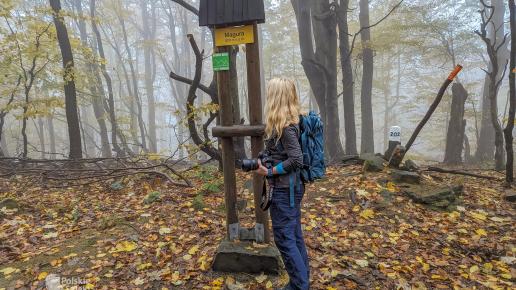
- Papal Trail to Magura- red GSB from Bartne, nearby and not too steep. The Magura Wątkowska range is covered with a beech forest, which is wonderfully coloured in autumn and looked magical in the fog. After entering the mountain to the right, follow the still red trail to Magura (829 m above sea level). It's just a few steps away, along the way you pass a viewpoint over the Tatras. On the other hand, green signs lead to Wątkowa (846 m above sea level). It's also very close. Both peaks are not scenic. The route bears its name in memory of the pilgrimage here of priest Karol Wojtyła, the later pope.
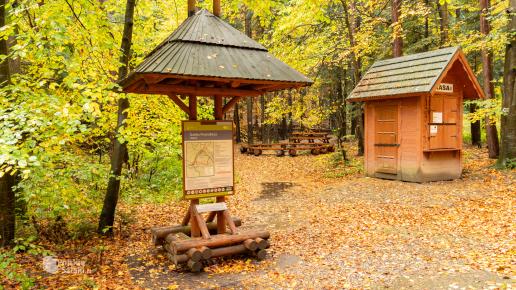
- Cycling route to Nieznajowa in the Wisłoka valley - a beautiful route, flat and comfortable, surrounded by the low domes of the Eastern Carpathians. You pass a symbolic door to the now-defunct village of Nieznajowa

- The black trail to Ferdel - we climbed it in the village of Wyżny Koniec, but it leads from Folusz and is 6.5 km long. Our route was shorter, just over 1 km, but it is very steep on this section. The effort is rewarded by the beautiful views from the observation tower, it is worth being here near the sunset
Experience map

We provide a map of the attractions of this National Park. It will probably come in handy when planning a trip.
Nature of the Magura National Park
Magura National Park is unique because as much as 95% of its area is covered with forests. Mainly natural beech forests. They hide valuable species of flora and fauna, often protected. Even those from the Polish Red Book. In addition to forests, you can also find meadows and pastures.
Flora of the Park
The Magura Park lies within the range of two plant floors: the foothills and the lower regla. About 70 species of typical mountain plants grow, e.g. omieg and modrzyk górski. Many species are under strict protection. The sycamore forests are very valuable here - rare in the Polish Carpathians. In addition to forest areas, there are meadows and numerous heathlands overgrown with, among others, nine stemless silt. In autumn, Magura meadows bloom beautifully in purple. This view ensures autumn winter. Beautiful, but poisonous. Nearly 800 species of vascular plants grow in the protected area. Strict protection concerns 59 species, partial protection 11 species. You will meet as many as 3 species from the Polish Red Book of Plants!


Fauna of the Park
The areas of the Park are a refuge for many animal species. From large predatory mammals, you can meet brown bears and wolves, which make up as many as 3 family packs. In addition, lynxes, wild boars or raccoon dogs. Deer are very numerous. More than 500 individuals live here. From smaller mammals you will see otters, martens, shrews or weasels. We managed to look out for the beaver, but he quickly got scared off. This is our first live encounter with this animal.

Noble crayfish appear in the rivers and streams here, which means that the water is clean. Another interesting fact is that MPN is one of the few places in Poland where all native species of caudate amphibians occur. 5 species! Newts: crested, common, mountain and Carpathian, and spotted salamander. We met the last one on the Magura trails several times. This unusual creature is of marvelous beauty. Interestingly, it was once believed that salamanders are born and live in fire. Is it because of her yellow spots, shouting "don't touch - I'm poisonous"? The amphibian actually has venomous glands behind its eyes, but it is not dangerous for humans, although it can irritate the eyes. It is a protected species, but quite popular in the Polish mountains.
Park is also charmed by the numerous rare species of butterflies, but the amazing blue beetle - the alpine beetle - deserves special attention. The PGE Foundation supported scientific research on this species.
MPN symbol - lesser spotted eagle


In the logo of the Park, you will see a lesser spotted eagle. It's a symbol of this place. MPN is the highest density of this bird in Poland. The largest population lives here - 25-30 pairs. You will meet him in the Park from April to September, because for the winter the birds fly away to warm countries. And more specifically to central or southern Africa.

Our video
I encourage you to see our film about the Magura National Park.
Parks Walker
Planning a visit to Roztocze Park will certainly be helped by the "Walker", which you can download here. Here you will find many interesting ideas for excursions. The stroller also treats other national parks in Poland, such as Biebrza National Park, Słowiński National Park, Roztoczański National Park or Wigierski National Park.
The article was created in cooperation with PGE Polska Grupa Energetyczna, which supports MPN.

Accommodation
Here you will find a wide selection of accommodations. By booking your stay on Booking.com through our link, you support the development of our blog — and we thank you in advance! It helps us reach many interesting places that we later love to show you and share our experiences and information with you.
Practical information
Magura National Park - Directorate
Krempna 59, Krempna
tel. 13/ 441-40-99
www.magurskipn.pl
Rent a car
Exploring becomes much easier when you have your own means of transport. You don’t have to worry about buses or taxis, and you can plan each day your way. The search box below will help you find the right car – right where your journey begins.
What's worth seeing in the area?
You don't have to travel far to find more interesting places. Within a radius of 100 kilometers, there are many attractions waiting for you that will certainly enrich your stay Your trip with additional memories.
- Biecz, distance: 32 km
- Krynica Zdrój, distance: 40.6 km
- Observation tower in Krynica Zdrój, distance: 42.6 km
- Stary Sącz, distance: 63.2 km
- Tarnów, distance: 68.5 km
- Szczawnica, distance: 74.1 km
- Three Crowns, distance: 79.4 km
- Pieniny National Park, distance: 79.4 km
- Limanowa, distance: 81.6 km
- Bochnia Salt Mine, distance: 94.3 km
